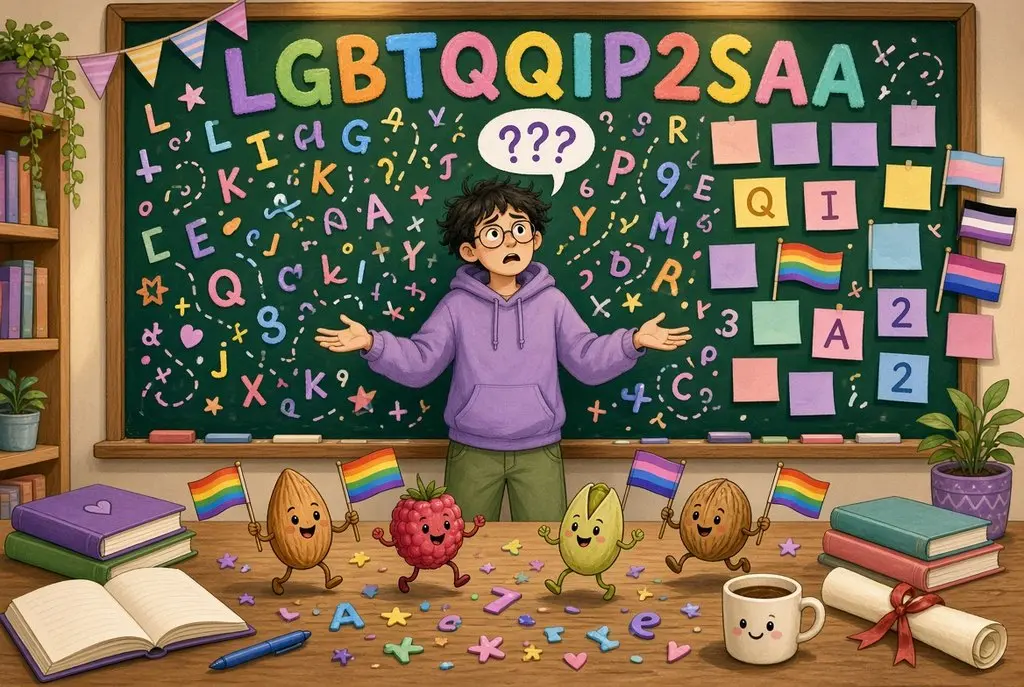
Carle Jasmin (Image : AI / )
It is no longer enough to learn the familiar words “gay,” “lesbian,” “bisexual” or “trans.” The expanding vocabulary of LGBTQ+ identities now includes terms such as Almondsexual, also called Verian, and Berrisexual. Even journalists who have specialized in LGBTQ+ communities for decades may need a glossary to keep up with the letters, numbers and microlabels now used to describe sexual orientation, attraction and gender.
From letters and numbers to almonds and berries
Among the longest documented combinations is LGBTQQIP2SAA. It contains 11 alphabetical characters and the number 2, making 12 characters in total:
L G B T Q Q I P 2 S A A
- L — Lesbian
- G — Gay
- B — Bisexual
- T — Transgender
- Q — Queer
- Q — Questioning
- I — Intersex
- P — Pansexual
- 2S — Two-Spirit
- A — Asexual
- A — Ally / Androgynous, depending on the source
That already makes the acronym difficult to decode. But the vocabulary has continued to expand, including with a designation that does not even use another letter from the familiar sequence. Almondsexuals, or Verians, have now joined the collection of identity terms. After so much of the alphabet has been used, almonds have apparently entered the discussion as well.
The name does not indicate a particular attraction to almonds, although that would perhaps be easier to explain. The alternative term Verian at least avoids the inevitable question: “So… do you sleep with almonds?”
An Almondsexual or Verian person is described as being primarily attracted to men and masculine people, as well as to certain non-binary, androgynous or gender-neutral people. Such a person may also occasionally experience some attraction toward women or feminine people.
The description is therefore not exactly “I like men,” but it is also not quite “I am bisexual.” It refers instead to a primary attraction toward men combined with a limited possibility of attraction to certain women. That distinction is considered sufficient to receive its own microlabel.
Berrisexuals are presented as something of an opposite equivalent, with attraction primarily directed toward feminine or feminized people. Keeping track of the LGBTQ+ alphabet now seems to require learning a vocabulary of fruits and nuts as well.
The question behind the proliferation
The stated purpose of microlabels is to give people more precise words for their identities and experiences. That intention is laudable. A term that helps someone understand what they feel and makes them feel less alone can be valuable.
Yet the growing number of categories also creates a classification system that can become practically impossible to understand. A person may need to memorize a sequence of letters, numbers, combinations and microlabels before knowing precisely what another person means. Even within LGBTQ+ communities, many people have to look up terms they have only just encountered.
Does every nuance require its own word, definition, flag and possibly acronym? If someone is primarily attracted to men but can exceptionally feel attracted to certain women, is a new category necessarily needed? At this rate, introductions could require something closer to a technical specification sheet than a first name and a sexual orientation.
There is also an irony in this development. A movement that has long defended the right not to be confined to boxes sometimes appears to have developed a strong attachment to boxes of its own. There are now so many that a map may be needed to find one’s place.
The issue is not that someone chooses a word that suits them. The difficulty begins when the succession of categories becomes more important than the person. A language intended to express individual experience can instead become an elaborate system that demands to be understood, memorized and used by everyone else.
What “label abolitionism” questions
To our knowledge, there is no structured international organization whose official objective is to eliminate microlabels from gay, lesbian and LGBTQ+ communities. There is, however, a school of thought known as label abolitionism, or “label abolitionism,” that questions the tendency to assign a name to virtually every nuance of sexual orientation, attraction or identity.
The debate contains a striking paradox. For decades, gay and lesbian communities demanded the right not to be confined by categories imposed by society. Terms such as “gay,” “lesbian” and “bisexual” helped make visible realities that had been ignored, criminalized or pathologized.
Over time, the main categories acquired subcategories, followed by microlabels intended to describe increasingly subtle differences in personal experience. When words were no longer sufficient, letters were added. When the available letters were insufficient, numbers appeared. When those options still did not suffice, another term was created.
That is how labels such as Almondsexual and Berrisexual can now require more explanation than the sexual orientation they are supposed to describe. The phenomenon is not necessarily absurd: for some people, a precise term can be liberating and can help them find others with comparable experiences.
Critics of “label abolitionism,” however, point to the difference between allowing individuals to define themselves as they wish and expecting society as a whole to know every new definition. This may be where the multiplication of microlabels reaches its limits.
Language does evolve, and new words appear constantly. But there is something ironic about needing a multi-page manual to understand someone who is simply asking to be understood. The multiplication of categories can ultimately reproduce the very obsession with classification that early LGBTQ+ rights movements sought to challenge.
Subgroups for subhumans?
By continually creating subgroups, subcategories and microlabels, are we diluting a shared identity until it means little to the general public? By naming every nuance, exception and variation in human experience, do we risk fragmenting a community that fought for decades to be recognized as a community?
And by subdividing, differentiating and classifying ourselves, might we be recreating, in a more sophisticated form, the mechanisms of hierarchy and exclusion that we claimed to oppose?
The objective was emancipation: escaping the boxes imposed by others and being recognized as human beings in our own right. Was the plan really to create a new series of small boxes in which we could once again confine and exclude people who are not like us?
Sometimes, those who demand the right not to be defined by others end up with the most sophisticated systems of definition in history.
Feel free to add your observations or comments in the form at the bottom of this page.
ADVERTISING


Comments