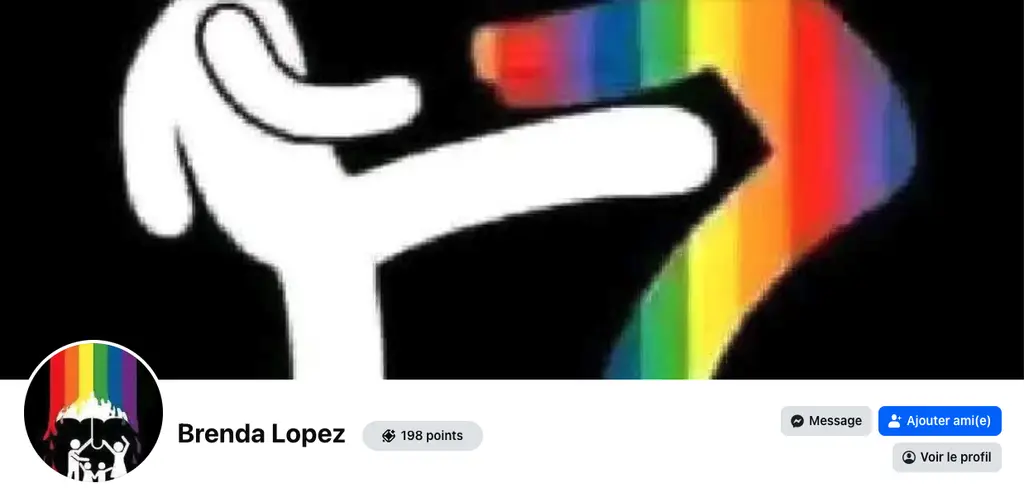
Carle Jasmin (Image: Facebook account of Brenda Lopez)
Good news: before this article was finished, the hateful message posted in the Les P’tits LGBT Facebook group had been removed. It was either deleted by the group’s administrators or taken down by Facebook after our report.
The removal followed a series of posts by a person presenting herself as Brenda Lopez. Her identity cannot be verified because her Facebook profile is locked. What can be seen, however, are numerous homophobic signals left in LGBTQ+ groups, including Les P’tits LGBT, along with repeated provocations aimed at members of these communities through hateful statements and images directed against us.
Four days ago, apparently seeking to stir up hatred toward LGBTQ+ people, she published a message about an alleged father of an 11-year-old boy who supposedly caught an 18-year-old having a sexual relationship with his son. She claimed that the father had beaten the 18-year-old almost to death, while also stating that he had not been charged by the courts. The post included the words: “Always these fucking homosexuals, bravo to this dad.”
Members of the Facebook group responded with numerous expressions of outrage.
The images on her page reinforce the same message. The main image at the top shows one person kicking another, with the person being kicked depicted in LGBTQ+ colors. Her profile picture shows parents with children beneath an umbrella, apparently trying to protect themselves from rain in LGBTQ+ colors. When group members asked why she posted such content, she notably answered: “xxx, because you are nothing but a bunch of assholes,” accompanied by a middle finger, among other things.
These posts illustrate how trolling can be used on social media, sometimes under the cover of anonymity, to provoke anger and spread hatred against particular elements of society. Trolling involves provoking people on the Internet and watching others become angry. The person doing it does not necessarily seek to advance an idea through debate; the objective may instead be to ridicule, exaggerate, attack or push an interlocutor to the breaking point.
Social media makes this approach especially visible. An intentionally outrageous post can attract hundreds of reactions within minutes. The more users become outraged, the more the troll generally regards the effort as successful. Anger becomes the fuel, while the algorithm becomes the best ally.
The method can involve deliberately spreading false information, posting insults, making political provocations or launching personal attacks. It can also consist of claims so absurd that they appear designed solely to trigger a response. Some trolls seriously assert something they know to be false and then accuse anyone who challenges them of having no sense of humor.
The boundary between trolling, disinformation and simple bad faith is not always clear. Repeated provocations can contaminate an ordinary conversation, draw attention away from the original subject and give disproportionate visibility to whoever shouts the loudest.
A recent example involved Toyota. The Brenda Lopez account published a claim during the night that Toyota was ending its sponsorship of LGBTQ+ events so that the money could instead be directed toward innovation and education. Framed this way, the announcement could appear encouraging to people who want to see every commitment to LGBTQ+ people disappear.
There was, however, a significant omission: the information dated from 2024 and had been presented without several essential elements. Toyota was not announcing that it was abandoning its internal “Diversity, Equity and Inclusion” policies, nor was it ending its commitments to LGBTQ+ people. The issue concerned the redirection of certain external budgets toward new internal programs.
Reading the complete information, rather than selecting only the words needed to construct a preferred message, would have provided that context. This is where trolling becomes more than ordinary provocation. By leaving out essential information, it turns a real event into a tool of disinformation. The purpose is no longer to inform, but to provoke a reaction, generate outrage or strengthen an audience that is already convinced.
When the target is an LGBTQ+ community and the same method is repeated in its own discussion spaces, the situation is no longer merely a disagreement between opinions. The pattern is predictable: present the bait, wait for the reactions and then feed on the anger that has been created.
In such circumstances, the appropriate response is not to react. Posts should be reported to the group administrators and to Facebook through the section dedicated to hate messages. At best, the account will be closed. At worst, nothing will happen.
ADVERTISING


Comments